Every growing business eventually faces the same question: should we buy ready-made software or build our own? Off-the-shelf tools promise a quick start and a low monthly fee. Custom software promises a perfect fit for how your business works. Both promises are partly true, and the right answer depends on your processes, budget, growth plans and how much of your advantage comes from doing things differently. This guide gives Indian businesses a practical decision framework covering flexibility, total cost of ownership and time-to-value, plus the hybrid options that often work best.
Definitions
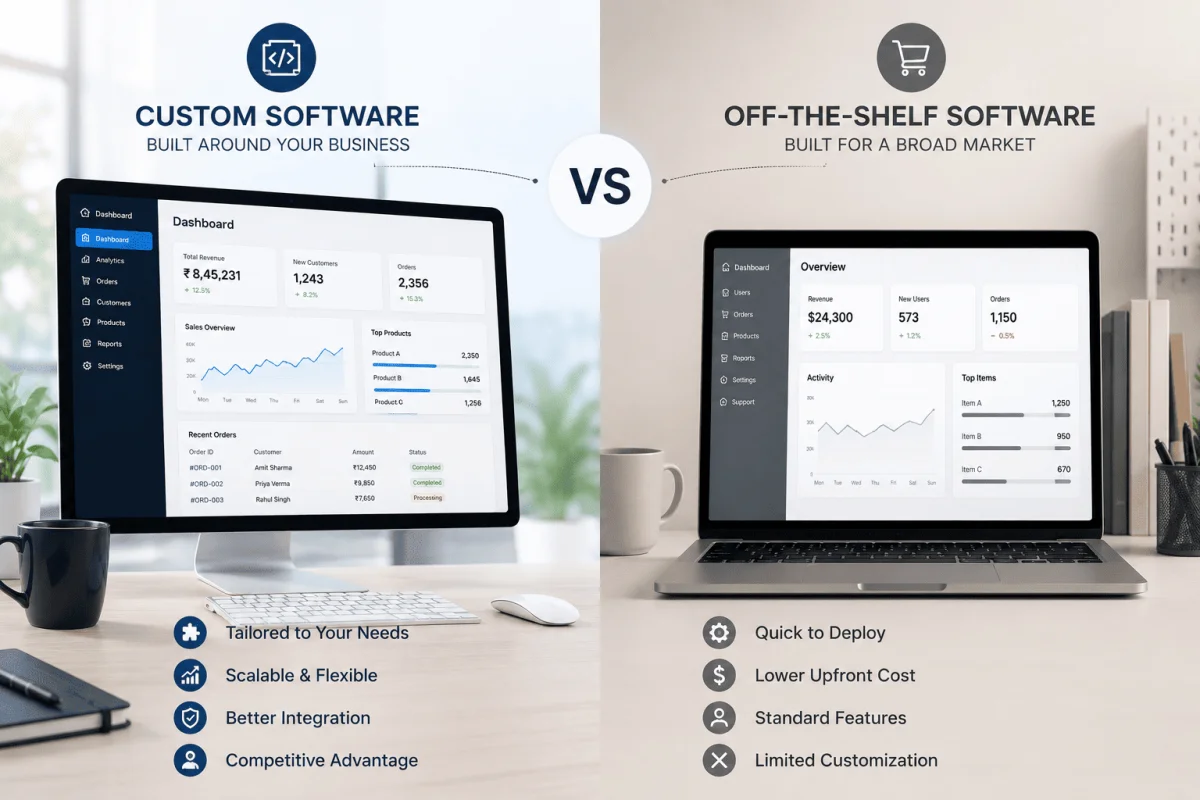
Off-the-shelf software is a ready-made product used by many businesses, usually sold as a subscription (SaaS) or licence. Examples include accounting packages, CRMs, HR tools and e-commerce platforms. Custom software is built or substantially configured for one organisation's specific needs, and the organisation typically owns or controls the code.
Side-by-side comparison
| Factor | Off-the-shelf | Custom |
|---|---|---|
| Time to start | Days to weeks | Weeks to months |
| Upfront cost | Low | Higher |
| Ongoing cost | Per-user or per-feature subscription, rising with growth | Hosting and maintenance, more predictable |
| Fit to process | You adapt to the software | Software adapts to you |
| Integrations | Limited to what the vendor supports | Built for your systems |
| Control and ownership | Vendor controls roadmap and pricing | You control features and data |
| Risk | Vendor changes, price rises, shutdown | Depends on partner quality and documentation |
When off-the-shelf is the right choice
- The process is standard across industries, such as email, basic accounting or payroll for a small team.
- You need to start quickly and validate an idea.
- Your team is small and the per-user cost stays low.
- The software already integrates with the tools you use.
- You do not gain a competitive advantage from doing this process differently.
When custom software makes sense
- Your workflow is unique, for example multi-step approvals in government departments, industry-specific production, or bespoke pricing.
- You are paying for several tools and still using spreadsheets to connect them.
- User-based subscription costs are growing fast as headcount grows.
- You need integrations with legacy systems, devices or local services.
- The software is part of your product or customer experience.
- You need control over data location, security or compliance.
Total cost of ownership: compare five years, not one
The fairest way to compare is to estimate total cost over three to five years. Include:
- Off-the-shelf: subscription per user per year, add-on modules, implementation and data migration, integration tools, training, price increases, and the cost of workarounds.
- Custom: development, hosting, annual maintenance (often 15–25% of the build cost per year), enhancements and training.
An illustrative example
Imagine a business with 80 users paying a typical subscription of ₹800 per user per month for a tool that covers most of its needs. That is about ₹7.7 lakh a year before add-ons, or close to ₹38 lakh over five years if prices and headcount stay flat. A custom system might cost, as a typical range, ₹10–25 lakh to build plus annual maintenance. The numbers are hypothetical and only show how to compare; with 10 users the subscription would clearly win. Run the calculation with your own figures.
Time-to-value
Time-to-value is how soon the software starts delivering real benefits. Off-the-shelf tools often deliver basic value faster, but businesses sometimes spend months bending processes to fit them. Custom systems take longer to build, but a phased approach, launching the most valuable module first in eight to twelve weeks, can deliver benefits early while the rest is built.
The hybrid approach
Many businesses get the best result by combining both:
- Use off-the-shelf tools for standard functions such as email, accounting and video calls.
- Build custom modules for the processes that make you different.
- Connect everything with APIs so data flows without re-typing.
- Start with a configurable product and customise it, rather than building from zero.
For example, an SME might keep Tally for statutory accounts, use a ready-made email platform, and build a custom ERP for orders, inventory and dispatch. Our guide on when SMEs should move from spreadsheets to ERP looks at this decision for operations software.
A decision framework in seven questions
- Is this process standard, or a source of competitive advantage?
- How many users will need access over the next three to five years?
- Which systems must it integrate with?
- What is the three- to five-year total cost for each option?
- How quickly do we need results, and can we phase delivery?
- Who will own and maintain the system?
- What happens to our data if we stop using the vendor?
If most answers point to "standard, few users, quick start", buy. If they point to "unique, many users, deep integrations", build or customise.
Reducing the risk of custom software
- Start with discovery and a clickable prototype before full development.
- Build in phases with working releases every few weeks.
- Insist on source code ownership and documentation.
- Choose a partner with a maintenance plan, not just a build team.
- Use proven frameworks rather than unusual technologies.
Our custom software development team builds web, mobile and enterprise applications for businesses in Bhubaneswar and across India, and we also offer ready-to-configure products such as our ERP system and HRMS. Contact us for an honest buy-or-build assessment.
Questions to ask an off-the-shelf vendor
- How does pricing change as we add users, branches or modules?
- Can we export all our data, including history, in a standard format?
- Where is our data hosted, and who can access it?
- Which integrations are included, and which cost extra?
- How much can we customise fields, workflows and reports without paying for development?
- What support is available in our time zone, and in which languages?
Clear answers to these questions often make the decision obvious, either because the product fits well or because the limits become visible early.
Whichever route you choose, write down the reasons and revisit the decision every year or two. Business needs change, and a tool that fit well at twenty staff may not fit at two hundred.
Frequently Asked Questions
Is custom software always more expensive?
Upfront, usually yes. Over several years, custom software can cost less than subscriptions for larger teams or complex needs. Compare total cost over three to five years.
How long does it take to build custom software?
Typically eight to twelve weeks for a focused first module and three to nine months for larger systems, depending on scope and integrations.
Can we start with off-the-shelf software and switch later?
Yes. Make sure you can export your data in a usable format so migration is possible when you outgrow the tool.
Who owns the code in a custom software project?
It depends on the contract. Ask for source code ownership or a clear licence to be written into the agreement.

Written by Deepankar Saha
Deepankar Saha has 16+ years of experience in software development and entrepreneurship. He leads Utility Cube Technologies, working with founders and operations teams to plan, build, and grow websites, applications, and business software they can run with confidence.