Once a web application goes live, someone has to keep it running: fixing bugs, applying security patches, renewing certificates, handling server issues and making small changes as the business evolves. In India, this is usually covered by an Annual Maintenance Contract, or AMC. A good AMC gives you predictable costs and fast help when something breaks. A vague one leaves you arguing about what is "included" while your customer portal is down. This guide explains what a web application AMC should cover, how to read service levels, typical pricing models, and the questions to ask before you sign.
What is an AMC for a web application?
An AMC is a yearly agreement in which a development or support partner maintains your software for a defined fee. It differs from a hardware AMC because software needs more than repairs: it needs updates to stay secure, compatible and fast. For a business website, booking system, customer portal, ERP or HRMS, the AMC is what keeps the system healthy after the original project ends.
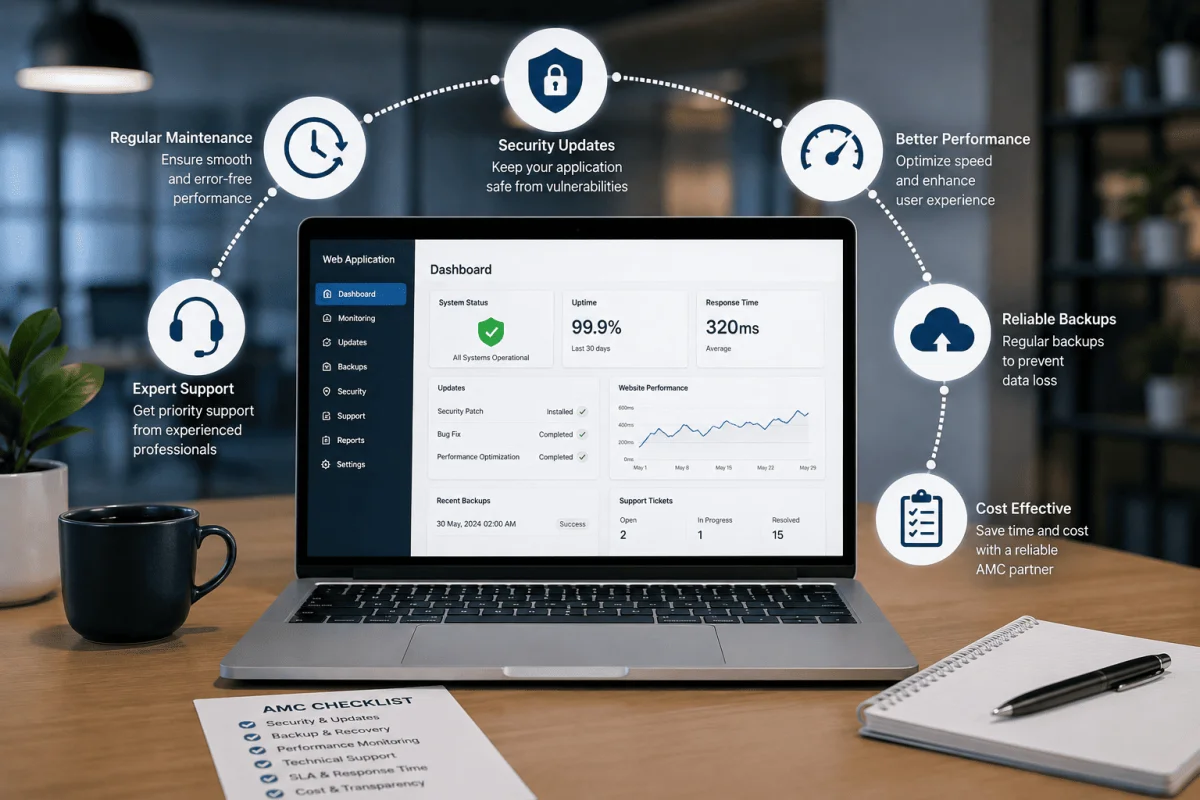
What a good AMC should include
Corrective maintenance
Fixing bugs and errors in the existing features, including problems found by users after launch.
Preventive maintenance
Security patches, framework and library updates, server software upgrades, SSL renewals, and checks on backups and logs.
Adaptive maintenance
Changes needed because the environment changed: a new browser version, a payment gateway API update, a change in GST or other rules, or a new hosting setup.
Monitoring and backups
Uptime monitoring, error tracking, regular backups and periodic restore tests.
Support hours for small enhancements
A bank of hours each month or year for small changes such as new fields, report tweaks or content updates.
Reporting
A monthly or quarterly summary of incidents, updates applied, hours used and recommendations.
What is usually not included
Be clear about exclusions so there are no surprises:
- Major new features or modules, usually quoted separately.
- Third-party costs such as hosting, domains, SMS, email or payment gateway fees.
- Fixing problems caused by changes made by someone else.
- Data entry or content creation.
- Complete redesigns or platform migrations.
Understanding SLAs: response vs resolution
A Service Level Agreement (SLA) defines how quickly the partner will respond to and resolve issues. Response time is how fast someone acknowledges and starts working on the issue; resolution time is how fast it is fixed or a workaround is in place. Good AMCs define both, by severity.
| Severity | Example | Typical response | Typical resolution target |
|---|---|---|---|
| Critical | Site or app down, payments failing, data breach | Within 1–2 hours | Within 4–8 hours or a workaround |
| High | Major feature broken for many users | Within 4 hours | 1–2 working days |
| Medium | Feature partly broken, workaround available | 1 working day | 3–5 working days |
| Low | Cosmetic issues, minor changes | 2 working days | Next planned update |
These are typical industry ranges, not commitments from any specific provider. Check whether SLAs apply during business hours only (for example, Monday to Saturday, 9:30 AM to 6:30 PM IST) or around the clock, and what it costs to extend coverage.
Escalation paths
When an issue is not resolved on time, you need to know who to call next. A good AMC lists a support contact, a technical lead and a senior manager, with phone numbers and email addresses. It should also say how issues are logged, such as a ticketing system, email or a support portal, so every request has a record.
Common AMC pricing models in India
| Model | How it works | Good for |
|---|---|---|
| Percentage of project cost | Often 15–25% of the original build cost per year | Stable applications with predictable needs |
| Fixed monthly or annual fee | Set fee for a defined scope and hours | Businesses that want predictable budgets |
| Hour bank | Pre-paid hours used as needed | Applications with irregular change requests |
| Tiered plans | Basic, standard and premium with different SLAs | Choosing coverage by criticality |
These are typical market patterns, not Utility Cube prices. Simple business websites usually need far less than a customer-facing portal or an ERP that runs daily operations.
How to choose the right AMC
1. Rate your application's criticality
If your hospital, store or office cannot work without the system, you need tighter SLAs and possibly extended hours. A brochure website can live with next-day support.
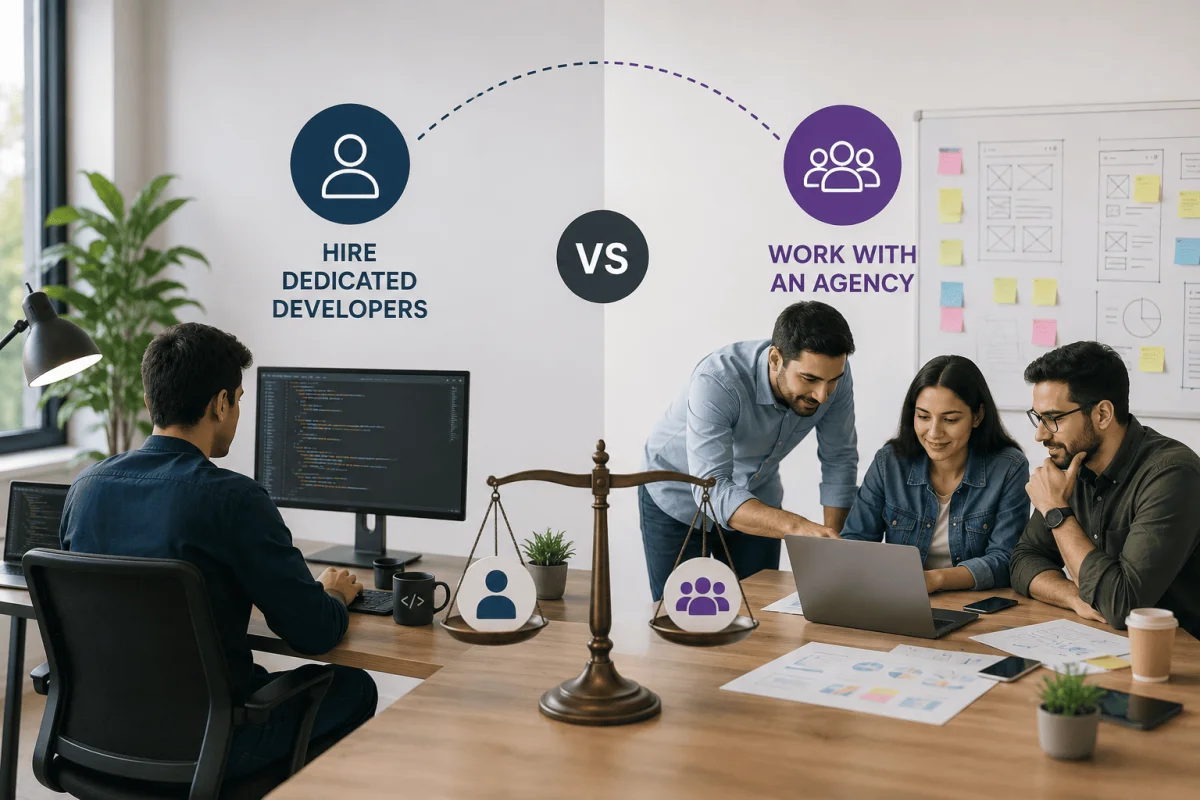
2. Check who will support it
The original developer usually understands the code best. If you are moving to a new partner, budget for a short code review and handover.
3. Insist on documentation and access
Make sure you own the source code, hosting accounts, domain and admin credentials, and that documentation is kept up to date.
4. Ask for sample reports
A monthly report shows whether the partner is actually doing preventive work, not just waiting for problems.
5. Consider local presence
For businesses in Bhubaneswar and Odisha, a partner who can visit for training or critical issues can be a real advantage, especially for ERP, HRMS or hospital systems used by many staff.
AMC checklist before you sign
- Scope of corrective, preventive and adaptive maintenance written clearly.
- SLAs defined by severity, with both response and resolution times.
- Support hours and channels specified.
- Monthly or annual enhancement hours stated, with rates for extra hours.
- Backup frequency and restore testing included.
- Security patching commitments defined.
- Escalation contacts listed.
- Exclusions and third-party costs listed.
- Code, data and account ownership confirmed.
- Exit clause and handover process defined.
For more on why preventive work matters, read why regular security updates matter for business websites.
Our software maintenance and support plans cover websites, custom web applications, ERP and HRMS systems with clear SLAs. Contact us to review your current AMC or set up a new one.
Reviewing your AMC every year
Treat renewal as a review, not a formality. Look at the number of incidents, how quickly they were resolved, how many enhancement hours were used and whether the application is on current, supported software versions. Adjust the plan's tier or hours to match how critical the system has become.
Frequently Asked Questions
How much does an AMC for a web application cost in India?
A common range is 15–25% of the original development cost per year, though fixed-fee and hour-bank models are also used. Cost depends on complexity, SLAs and support hours.
Is hosting included in an AMC?
Usually not. Hosting, domain and third-party service fees are typically billed separately, although some providers bundle managed hosting.
Can a different company maintain software built by another developer?
Yes, if you have the source code, access and documentation. Expect an initial review period so the new team can understand the code.
What is the difference between response time and resolution time?
Response time is how quickly the issue is acknowledged and work begins. Resolution time is how quickly it is fixed or a workaround is in place.

Written by Deepankar Saha
Deepankar Saha has 16+ years of experience in software development and entrepreneurship. He leads Utility Cube Technologies, working with founders and operations teams to plan, build, and grow websites, applications, and business software they can run with confidence.