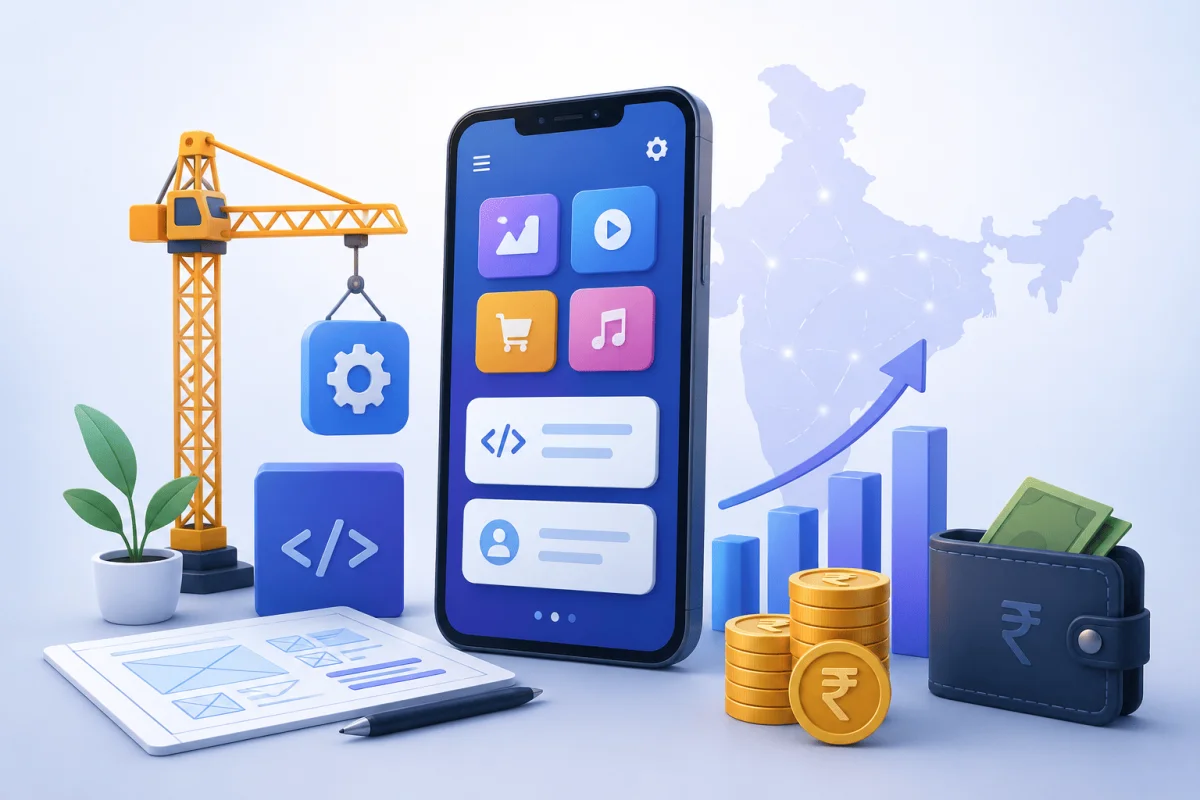
"How much does it cost to build an app?" is one of the first questions every founder and business owner asks, and the honest answer is: it depends on what the app needs to do. A simple booking app and a multi-vendor marketplace can both be called "an app", but one may cost ten times the other. This guide breaks down typical mobile app development costs in India in 2026, the difference between native and cross-platform builds, realistic timelines, and the hidden costs that often catch founders off guard.
Typical mobile app cost ranges in India
The ranges below reflect what Indian development teams commonly charge in 2026. They are typical market ranges for planning, not quotes, and actual prices depend on scope, design and the team you hire.
| App type | Examples | Typical cost range | Typical timeline |
|---|---|---|---|
| Simple app | Information app, catalogue, basic booking | ₹2–6 lakh | 6–10 weeks |
| Medium complexity | Login, payments, notifications, admin panel | ₹6–15 lakh | 10–16 weeks |
| Complex app | Marketplace, real-time tracking, multiple user roles | ₹15–40 lakh+ | 4–8 months |
Freelancers may quote lower, and large firms higher. What matters is what is included: design, backend, admin panel, testing, deployment and post-launch support.
What drives the cost
Features and user roles
Every user type (customer, vendor, delivery partner, admin) adds screens, rules and testing. A food delivery-style app with three apps plus an admin panel is far more work than a single customer app.
Backend and admin panel
Most apps need a server, a database and a web-based admin panel to manage users, content and orders. This is often 30–50% of the total effort, and is easy to forget when comparing quotes.
Integrations
Payment gateways such as Razorpay or PayU, SMS and WhatsApp notifications, maps, GST invoicing and ERP or CRM connections each add time.
Design quality
A template-based design is cheaper; a custom, tested UI/UX design costs more but usually improves conversion and reduces later rework.
Native vs cross-platform
| Approach | Technology | Pros | Cons |
|---|---|---|---|
| Native | Swift (iOS), Kotlin (Android) | Best performance and device access | Two codebases, higher cost |
| Cross-platform | Flutter, React Native | One codebase for Android and iOS, faster | Some limits for very hardware-heavy apps |
| Progressive web app | Web technologies | Cheapest, no app store needed | Limited offline and device features |
For most Indian startups and SMEs, cross-platform development is the practical default. It typically saves 25–40% compared with building two native apps. Since most Indian users are on Android, some businesses launch Android first and add iOS later.
Hidden and ongoing costs
- App store accounts: Google Play has a one-time developer fee and Apple charges an annual developer membership.
- Hosting and cloud services: servers, databases, storage and backups, often a few thousand rupees a month for a small app and more as users grow.
- Third-party services: SMS, OTP, email, maps and push notifications usually charge per use.
- Payment gateway fees: a percentage of each transaction.
- Maintenance: OS updates, bug fixes and security patches. A common planning figure is 15–25% of the build cost per year.
- Marketing: an app with no users has no value; budget for launch and growth.
Ongoing care is often handled through an annual app maintenance and support plan.
How to reduce cost without cutting quality
- Start with a minimum viable product: the smallest version that solves the core problem.
- Choose cross-platform unless you have a specific native need.
- Use proven services for login, payments and notifications instead of building them.
- Write a clear scope document before asking for quotes, so you compare like with like.
- Plan phases: launch, learn from users, then add features.
If you are planning a software product rather than a single app, our breakdown of SaaS MVP cost in India covers the extra work involved in subscriptions and multi-tenant systems.
Questions to ask before you hire an app developer
- Is the admin panel and backend included in the quote?
- Who owns the source code and the app store accounts?
- How many rounds of design revisions are included?
- What testing is done, and on which devices?
- What does support cost after launch?
- Can I meet the team? Local teams in Bhubaneswar or elsewhere in Odisha make in-person workshops easy.
To get a realistic estimate for your idea, explore our mobile app development services or share your requirements with us.
A sample cost breakdown
To make the ranges more concrete, here is how effort is typically split on a medium-complexity business app, such as a service-booking app with customer login, payments and an admin panel. Percentages are typical, not fixed:
| Work area | Typical share of effort |
|---|---|
| Discovery and scope | 5–10% |
| UI/UX design | 10–15% |
| App development (Android and iOS) | 30–40% |
| Backend, APIs and admin panel | 25–35% |
| Testing and launch | 10–15% |
If a quote puts almost everything under "app development" and very little under backend or testing, ask what is missing.
Fixed price or time and materials?
Fixed-price contracts suit small, well-defined apps; you know the cost upfront but changes need formal change requests. Time-and-materials or monthly team models suit evolving products where features will change after user feedback. Many Indian businesses use a fixed price for the first version and a monthly retainer for ongoing improvements. Whichever you choose, insist on milestone-based payments tied to working builds you can test on your own phone.
Typical development stages
- Discovery: goals, users, features and a clickable prototype.
- Design: screens, user flows and a simple design system.
- Development: app, backend and admin panel in two-week sprints.
- Testing: on real Android and iOS devices, including low-end phones.
- Launch: store listings, approvals and monitoring.
Planning for the Indian market
Design for a wide range of Android devices and screen sizes, support UPI payments, keep app size small for users on limited data, and consider regional language support, such as Odia or Hindi, if your customers prefer it.
Frequently Asked Questions
What is the minimum cost to build an app in India?
A simple app with a few screens and a basic admin panel typically starts around ₹2–6 lakh with a professional team. Very low quotes often leave out the backend, testing or support.
How long does it take to build a mobile app?
Typically six to ten weeks for a simple app, ten to sixteen weeks for a medium-complexity app, and four months or more for complex platforms.
Is Flutter or React Native better for my app?
Both are mature and suitable for most business apps. The right choice depends on your team's experience and any specific device features you need.
How much does app maintenance cost per year?
A common planning figure is 15–25% of the original build cost per year, covering updates, fixes, security and minor improvements.

Written by Deepankar Saha
Deepankar Saha has 16+ years of experience in software development and entrepreneurship. He leads Utility Cube Technologies, working with founders and operations teams to plan, build, and grow websites, applications, and business software they can run with confidence.